300x250 AD TOP

AD (728x90)

Mostrando entradas con la etiqueta Spanish ab initio paper 2. Mostrar todas las entradas
Tagged under: , , , , , , , , , , ,

Prueba 2: set #1

Remember that Paper 2 is going to weight 25% of your final score and it has two sections:

- A: choose one task out of two [50 words]
- B: choose one task out of three [100 words]

Also, it is crucial that we know the features of the text we have to write to score highly.

Instructions:
1.- Read the instructions carefully
2.- Choose your tasks and answer in the space provided
3.- At the end of the presentation click on "exportar el texto", a .doc file will download into your computer with the prompts and your writings
4.- Turn it in to your teacher
5.- Read his feedback carefully
6.- Come up with an action plan to improve and set a specific goal and time to review your progress
7.- Review your progress

More resources for Spanish ab Initio Paper 2:


Sharing will enrich everyone
with more knowledge
Anna Monnar
Tagged under: , , , , , , , , , , , ,

Writing visual activities to get started with paper 2 in ab Initio

We, teachers, know that abInitio is a tough course and we are always looking for new ways of helping our students to rush through the syllabus. 
I found this activity great to help my students to develop their writing skills at the very beginning, scaffolding them with visuals to come up with a story. But also works great with more advanced students to help them develop more creativity in their tasks.

Remember that is also crucial that all your writing activities involve text types format, as it is taking into account when it comes to grading.


Ab Initio paper 2 resources
El individuo y la sociedad
Trabajo y ocio
El medio urbano y rural
Cuestiones globales
Datos personales, apariencia y carácter
Geografía física
Medios de comunicación
La ciudad y sus servicios
Relaciones
Tiempo meteorológico
Salud física

All images used are from http://publicdomainvectors.org/, if you are looking for free images to use in your classes, I highly recommend this site, it is awesome!


Too often we give children answers to remember
rather than problems to solve
Roger Lewin

Tagged under: , , , , , , ,

Text types: la presentación

A presentation is linked to oral communication and formal language. Another convention you must have on your presentation is a structure. The most typical one is introduction, development of your ideas and conclusion. The main purpose of this type of text is to inform an audience. Then, we can use an informative text features to elaborate a presentation.

Main features:
  • includes some type of greeting at the beginning and salutation at the end
  • Register will be basically formal although some informal register will be admitted too
  • express a personal point of view on the topic
  • support your ideas with examples
Tips on how to do a presentation [pdf]

Useful links:
Knowledge is the food of the soul
Plato
Tagged under: , , , , , , , , , , ,

IB Spanish text types: el folleto informativo

The purpose of this text type is usually persuading people. So, make that connection and think in what a persuasive text looks like and then apply those features to this. In addition to that, pay attention to the design and format, which can be the key for getting this type of text right.

There is another key concept we have to keep in mind when writing a brochure, pamphlet... we want to communicate accurate information quickly, in a precise way. No misunderstandings wanted, so be straight forward. Try to include some catchy phrases, bring in your creativity this is the perfect format to express yourself.

To work on this text type with your students check the links provided below.


Don't forget to link this knowledge with their paper 2 and the rubrics they have to use. To make sure you don't miss anything, check out the related posts underneath.

Cómo escribir un folleto dando instrucciones

1. Usa el imperativo. Debes decidir si usar el imperativo formal o informal
según el destinatario.

2. Usa marcadores. Si explicas un proceso, necesitas incluir marcadores
como:

  • En primer lugar,
  • Primeramente,
  • Primero,
  • En segundo lugar,
  • Seguidamente,
  • Después,
  • Para empezar,
  • Más tarde,
  • Al + Infinitivo

Ejemplo: “Al llegar al aeropuerto, busca la parada de taxis.”

3. Organiza la información en párrafos claramente diferenciados.
Incluye un título, que puede ser una pregunta:
“¿Cómo se llega a Málaga desde Madrid?”

Related posts:

- Text types [for IB classes]
- Spanish B Rubrics & more
- Spanish ab Initio Rubrics & more 

Expand your boundaries:

Develop a passion for learning.
If you do, you will never cease to grow.
Anthony J. D'Angelo
Tagged under: , , , , , , ,

IB Spanish text types: el informe

This type of text has to be concise, accurate, refer to exact information, rigorous, data driven, impersonal and objective, although sometimes you can find some persuasive elements. 

How do I write in a impersonal way? For this purpose we can use passive voice, using verbs as nouns, describe the situation in a general way never referring specifically to a person.

Sometimes you can find a personal opinion in some reports, usually an expert expressing his professional opinion.

Essentially reports are not meant to be expressive, so everything superfluous is banned. These texts are functional and have to follow very clear goals. Some well-known examples are PISA reports on education.

A typical structure for reports is:
  • Summary
  • Introduction
  • Body
  • Conclusion
  • Appendix 
Expand your boundaries:
Tagged under: , , , , , , , ,

IB Spanish text types: Blog

Changing our perspective on what we have known is essential to approach this type of text: the blog. What is it? It can be said it is a digital text. What again, what "digital text" really means?  
It means that the format is digital, is telling us where can we find these texts. The digital world is too new for us yet, and this is what is giving us trouble categorizing a blog. Let's step into a quick activity to find out what a blog really is.

Instructions: Base your answer on the table above. What type of text would you say a blog is?
Use the table above to answer this question. Provide at least two evidences to support your answer.


 What type of text is a blog?

 Sí
No 
Porqué 
 Narrativo


 Descriptivo


 Dialogado


 Expositivo


 Argumentativo


After completing this activity you should have realized that blogs step in some different types of texts. So, what's the next question? 
What makes a text a blog?
Answer:

In a telegraphic way, if you are writing a blog, don't forget to include:
• Date, time and username
• Title
• Use the first person when writing (yo)
• Awareness of your audience (make it easy, make it direct, start with a paragraph mentioning your audience)

• Register (usually informal, but pay attention to the specific instructions of the task)

As you probably have noticed we are modeling in this post how to guide our students through this tough concept to gain this knowledge by themselves.
At this point, if you want to share the main characteristics or some interesting thoughts on blogs you can use this summary.
Don't forget to link this knowledge with their writing paper and the rubrics they have to use. To make sure you don't miss anything, check out the related posts underneath.

Related posts:
- Spanish B Rubrics & more
- Spanish ab Initio Rubrics & more

Expand your boundaries:
Develop a passion for learning.
If you do, you will never cease to grow.
Anthony J. D'Angelo
Tagged under: , , , , , , , , ,

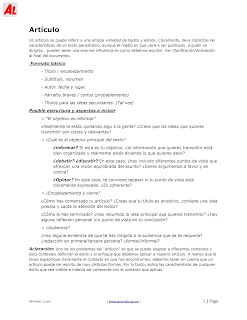
IB Spanish text types: Article

Writing skills have to be combined with text features deep knowledge to have the opportunity to score highly in your exams. Being a great writer also means knowing the specific features of each type of text to be able to reach the expectations of your readers and to make sure your intentions materialize on paper. That is the perfect combination to score highly in your Paper 2 and Written Assignment. 

The article is a very open, and therefore complicated, text type. It can be very heterogeneous in terms of features, audience, communicative goal and structures. But basically, you can divide this text into three different sections with two different intentions: 

  1. Communicate information to inform your audience [objective] 
  2. Express and opinion trying to persuade your audience about something [subjective]

There are so many different good resources out there that's why in this post besides attaching my documents I've made a compilation of what I think are the best resources available online. 

 Types of articles
Goal: To inform a targeted audience. [Texto expositivo/informativo]

This type of text is constructed to tell or advise you on something.

Useful links:
Goal: To debate/discuss ideas. [Textos expositivos y argumentativos]

To be able to debate ideas and convince people you will need to present the information and provide different perspectives, contrast information and express your opinion.
Don't forget to include advantages and disadvantages, positive and negative sides of the argument...
You will need to combine both types of texts and their features.

Goal: To express an opinion and/or have an impact on somebody's opinion. Artículo de opinión. [Texto argumentativo/persuasivo]

Usually this type of text is written to make you do something: persuade about something, buy an item...

Useful links:

Expand your boundaries:
Develop a passion for learning.
If you do, you will never cease to grow.
Anthony J. D'Angelo

Patreon

Help

POPULAR

RECENT

Recent Posts Widget